
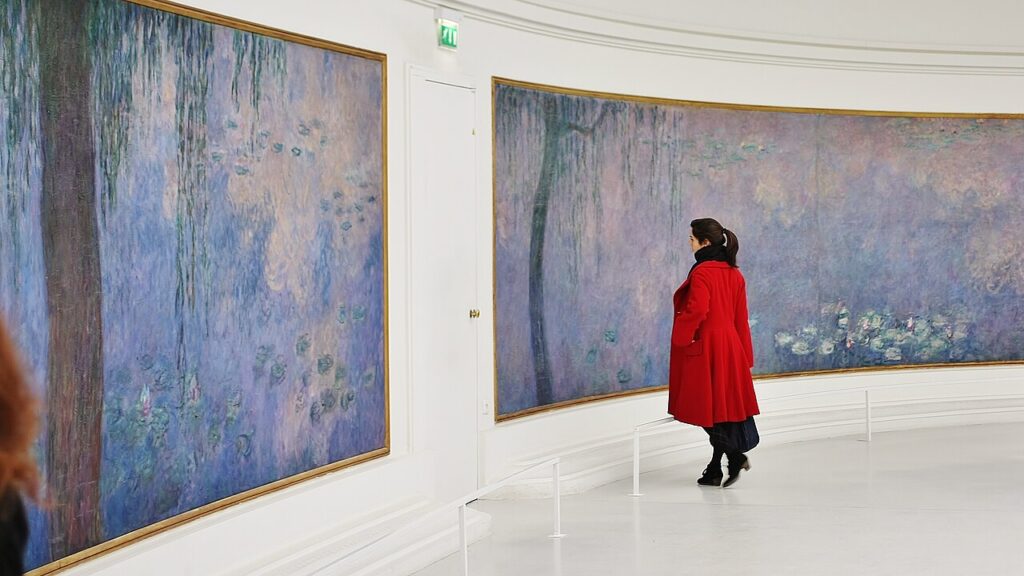
Most visitors to Paris know the Musée d’Orsay for Impressionism, but the Musée de l’Orangerie offers something the larger museum can’t: intimacy with Monet‘s final masterwork. Located at the western edge of the Tuileries Garden, this small museum centers on eight massive Water Lilies panels that wrap around two purpose-built oval rooms on the ground floor.
Claude Monet painted these murals in his Giverny garden during the final decades of his life, intending them as a gift to France after World War I. The artist supervised the installation himself, and the rooms opened to the public in 1927, months after his death. The effect is precisely what Monet wanted: a circular sanctuary where visitors are surrounded by his vision of water, light, and reflection.
The Water Lilies Rooms
The two oval galleries are the museum’s heart. Enter the first room and you’ll find yourself enveloped by four panels showing Monet’s pond at different times of day. The paintings have no frames, no barriers—just you and sweeping fields of blues, greens, and violets punctuated by floating lilies.
The second room continues the immersion with four more panels, including the stunning Morning and Sunset compositions. The natural light filtering through the skylights changes throughout the day, exactly as Monet intended. The paintings shift with the light, just like the surface of a real pond.
There are benches in the center of each room. Use them. This isn’t a museum for rushing through. Sit for ten minutes and watch how the paintings reveal themselves slowly—the way reflections dissolve into abstraction, how color becomes structure, the sense of looking down into water and up at sky simultaneously.
The Walter-Guillaume Collection
The lower level holds the museum’s other treasure: the Walter-Guillaume Collection, one of the finest groups of early modern paintings in Paris. Dealer Paul Guillaume and his widow Domenica assembled works by Cézanne, Renoir, Picasso, Matisse, Modigliani, and Soutine between the 1910s and 1930s.
The Modiglianis are particularly strong—sensual portraits and nudes that show the Italian artist at his best. Look for Young Apprentice and the portrait of Paul Guillaume himself. The Cézanne still lifes demonstrate why he’s called the father of modern art, while Renoir’s late bathers glow with rosy light.
Soutine’s visceral paintings of carcasses and twisted landscapes make a sharp contrast to the serene water lilies upstairs. The collection isn’t large, but every painting counts. You can see the entire lower level in an hour.
Practical Information
The museum sits at Place de la Concorde, right where the Tuileries Garden meets the massive square. The closest metro stops are Concorde (lines 1, 8, 12) and Tuileries (line 1). From either station, it’s a short walk through the garden.
The Musée de l’Orangerie is open daily except Tuesday, from 9 a.m. to 6 p.m. Lines form quickly, especially on weekend mornings and rainy afternoons when visitors seek indoor activities. Book tickets online in advance to skip the queue, or arrive right at opening for the calmest experience in the Water Lilies rooms.
The museum is included in the Paris Museum Pass, which also covers the Musée d’Orsay, the Louvre, and dozens of other institutions. If you’re planning to visit multiple museums, the pass saves both money and time.
Give yourself at least ninety minutes for a complete visit—thirty minutes in each Water Lilies room and another half hour for the lower galleries. The museum has a small bookshop with excellent art books and a café in the garden-level foyer serving coffee and light snacks.
Why Visit the Orangerie
In a city packed with world-class museums, the Orangerie offers something rare: a focused, contemplative experience. There are no vast galleries to navigate, no crowds jostling for position in front of a single famous painting. Just two perfect rooms and a strong supporting collection.
The Water Lilies represent Impressionism’s endpoint—the moment when Monet’s obsession with light and color dissolved representation entirely. These paintings influenced the Abstract Expressionists decades later and still feel radical today. Standing inside them is like standing inside Monet’s vision itself.
Visit on a weekday morning if possible, when light streams through the skylights and you might have one of the oval rooms nearly to yourself. Pair it with a walk through the Tuileries Garden or cross the Seine to explore the Left Bank galleries of Saint-Germain-des-Prés.
Want more stories about Paris’s hidden museums, secret gardens, and neighborhood gems? Subscribe to the Love Paris newsletter and get one short story delivered to your inbox every day.
Tours & experiences in Paris


Powered by Viator. Some links are affiliate links — we may earn a small commission at no extra cost to you.